|
Digital archiving primer
An introduction to electronic
archiving for newcomers to the subject.
|
eArchiving
General Model
v2.0
|
Use eArchivingThe aim of eArchiving is to provide the core specifications, software, training and knowledge to help data creators, software developers and digital archives tackle the challenge of short, medium and long-term data management and reuse in a sustainable, authentic, cost-efficient, manageable and interoperable way. The core of eArchiving is formed by Information Package specifications which describe a common format for storing bulk data and metadata in a platform-independent, authentic and long-term understandable way. The specifications are ideal for migrating long-term valuable data between generations of information systems, transferring data to dedicated long-term repositories (i.e. digital archives), or preserving and reusing data over extended (and shorter) periods of time and generations of software systems. Next to the specifications eArchiving offers a set of sample software to demonstrate the format in different scenarios and business environments, and consultancy in regard to long-term digital preservation risks and their mitigation.
How to get started?Using eArchiving starts with mapping your digital preservation problem to the eArchiving format specification and tool portfolio. That is to select the right format specifications and tools that best address your problem. Finding the right eArchiving components is not always easy. You have to understand the logic behind the eArchiving elements and have some knowledge of the eArchiving use cases, specifications and tools. This section aims to help newcomers to digital archiving or to the eArchiving Building Block find the best solution. We guide you through the eArchiving concepts, approaches and elements:
OAIS Reference ModelThe conceptual starting point of the information package specifications, use cases and process of the E-ARK project was the Open Archival Information System (OAIS) Reference Model (https://public.ccsds.org/pubs/650x0m2.pdf). The OAIS Reference Model is designed as a conceptual framework of a digital archive. The model defines three types of information packages and a set of electronic archival processes.
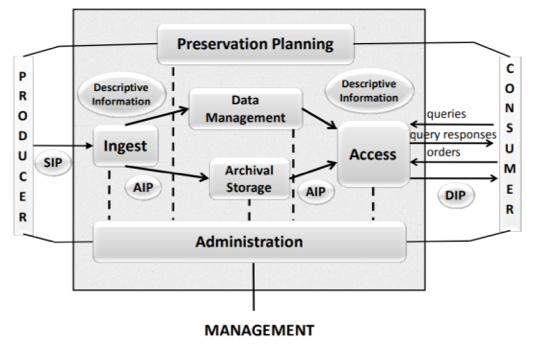
OAIS Functional Entities (source: public.ccsds.org) An information package, according to the OAIS model, contains the archival content along with descriptive and technical metadata. The three information package types are:
The processes of an OAIS archive are:
The above list is often extended with a Pre-Ingest process. Pre-Ingest covers the data and metadata assessment and compilation into the Submission Information Package. The Pre-Ingest process is usually performed by the data producer institution (Producer). |
|